Son Little
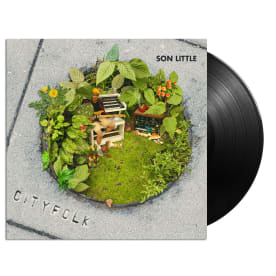
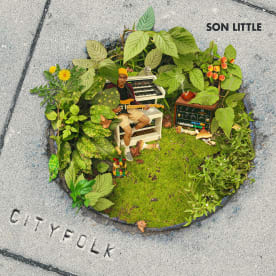
Curiosity about his ancestry has led songwriter and multi-instrumentalist Son Little on a journey throughout the American South that has resulted in his new album, simply titled CITYFOLK. The West coast born, Northeast-bred musician finetunes his craft here and speaks for those enduring tribulations about finding their place in the world.
Little, whose real name is Aaron Livingston, has sonically traveled practically everywhere that his songwriting and instrumentation have taken him, especially since the beginning of the 2020s. He’s toured with the likes of Black Pumas, Kelis and Mumford & Sons, and made festival appearances at Newport Folk and Bonnaroo, melding his dedicated fanbase with mainstream listeners. On the soulful fluidity of that year’s project aloha, the ANTI Records act braves his way through realizations about his personal shortcomings but endeavors to persevere through the madness. 2022’s Like Neptune unspools Little’s time in therapy, no longer silencing his inner fire. With a catalog that has amassed over 250 million streams, Little’s originality has embarked on a new chapter.
Now living outside of Atlanta, Livingston attributes the development of CITYFOLK to going even further south to record in Muscle Shoals, Alabama, in January 2025. It was there that Little, whose past collaborations include The Roots and RJD2, connected with two-time Grammy-winning musician and Alabama Shakes band member Ben Tanner to flesh out sketches of songs that he’d crafted through epiphanies about his family’s roots. Already having an understanding of his father’s side, Little views his maternal line as a “mystery unfolding,” but it was in Shoals that the stars aligned, both through retracing his history and formulating an organic chemistry with Tanner.
But it wasn’t an intentional journey: Little was guided by water through the misfortune of pipes bursting in the basement of his Atlanta residence. The space flooded several times, and at one point, it occurred just as wildfires were raging in Los Angeles, where Little traveled to record a collaborative project. Life presented an obstacle, but Little went with instinct by flowing through the madness. Shoals would become his escape route, and in channeling Mavis Staples–who Little worked with on 2015 EP Your Good Fortune–Otis Redding, and other pioneers who took up space in the small town in times past, Little cemented an audible manifestation of his journey.
“Just by showing up it brought something out,” Little explains. “I realized, in moving here, that my mother's people all came from this area, from South Carolina, Georgia–I thought a lot about how interesting it was that I would just sort of gravitate and migrate to a place where I had history.”
“Sometimes the spirits will guide you to a place when you don't even know you don't know why you found yourself there,” Little continues.
Before immersing himself in the home studio of Tanner’s residence in Shoals, Little recorded voice note demos with subtle instrumentation that became the framework of CITYFOLK. The acoustic demos would soon be mixed with drum machine beats before evolving into live material with contributions from a drummer, bassist and horn players. Jam sessions fully brought CITYFOLK into existence, while the unchanging southern comfort and musical richness of Shoals remained a backdrop to the album’s hymnal stew. In the late 1960s, the Muscle Shoals Sound Studios housed unbridling protest anthems and melodious love songs that would become the classics of tomorrow. Little’s CITYFOLK is a relic in the musical path paved for him.
“Its whole reputation and businesses are thriving because of the spirit of unity,” Little says of the small Alabama town. “I mean, it's all due to music that was created in defiance of that legacy. It's a place that I think really is a symbol of what can be accomplished when those barriers are broken down.”
Surfacing through Little’s microcosm of Shoals was sounds that embody the spirit of ancestral folklore. The banjo is strummed at a rhythmic church-stomping pace on “Rabbit,” where Little strives for peace amid societal upheaval. “Whip the Wind” grooves with Afro-Latin polyrhythms, its hook driven by a constant shaker and a silky synth melody that recalls early-1970s Stevie Wonder. But the song sticks to Little’s true form: despite its danceable feeling, the song is a call to recognize the human cost of power before it’s too late. The musician’s message becomes even more urgent on “Paper Children,” an outcry for those downtrodden and forced into inherited hardships. “Time has come to testify, there’s another Trail of Tears tonight,” Little wails on the song’s second verse.
Although often placed in the category of “roots musician”, on CITYFOLK, Little, who NPR praised for having “impeccably crafted songs,” continues to defy genre but lets the evocation of his storytelling pierce through. “The industry likes to keep artists in little boxes, and for Black artists it has meant being defined by your proximity to ‘urban,’” Little admits. “But my music has always had had flashes of country, rock and folk, as well as hip-hop, blues and R&B. So I've always struggled as an artist who kind of, I think, lives in the spaces between genres.”
“And although I once thought streaming would finally dissolve some of the barriers that pigeonhole artists, it’s turned out to be the opposite,” he continues.
The album is also an opportunity for listeners to discover Little as more than a vocalist, but a well-rounded artist who carefully balances DIY production, songwriting and vocal arranging. It’s a hands-on process that authentic voices like Little haven’t lost as artificial intelligence threatens the music industry.
“For me, it doesn't really matter what you feed the AI; it will never be equal to a human artist following an inner voice. There’s already a lot of hollow, derivative music out there made by humans; the sad part is, that a lot of people won’t know the difference!’
Between takes on CITYFOLK, Little and co-producer Tanner and crew cut through the small talk by mulling over big issues of the day, often informed by or informing lyrical choices as the songs went from demos to their final forms.
“These times we're in, where it feels like things in the outside world are blowing up or burning down, one of the artistic impulses can be [to] really get really introspective off that,” Tanner says. “Like, Well, if there's chaos everywhere right here, like, what can I do about myself to cope or to deal or to control my immediate relationships in spite of all that?”
While assisting with shaping Little's narrative, Tanner says that working with him has driven him to adopt a percussive and multi-layered element to his own music. “At the core, there is something that is very roots driven. It's song-driven, he has the song craft and the musical ability like any of these songs, he can sit with a guitar or at piano and play and sing the song and communicate the song that way,” Tanner explains. “So in some ways there's something that is a little bit old school in a good way, but in the making of the record there's sort of a lot more at play.”
He continues, “There's lots of hip hop influence and more modern R&B and indie rock. I think the musicality that he's bringing to being like a singer-songwriter is unique and different from anybody I'm really aware of.”
CITYFOLK builds upon the foundation that Little has laid for decades, and, like the aftermath of his basement flood, the album divinely re-routes the musician back to self and revitalizes the need for lasting music when it seems that all hope is lost.
See All Videos
"Cityfolk"
See All Recent Press
- Son Little Shares Four-Song Audiotree Live Session
- Son Little Shares "Whip The Wind", New Album 'CITYFOLK' Out This Friday & On Tour Now
- Son Little Shares Tender Song "Cherry" + Announces East Coast Tour Dates; New Album 'CITYFOLK' Out March 20
- Son Little Announces 4th Album 'CITYFOLK', Listen To "Be Better" Now
- Son Little by Jasmin Valcarcel
- Son Little Bio (2026)
-
Sep 24th 2026
Audiotree Live

See All Online Store
-
Son Little - Cityfolk LP (Black)
$23.99 Purchase -

aloha LP
$17.99 Purchase